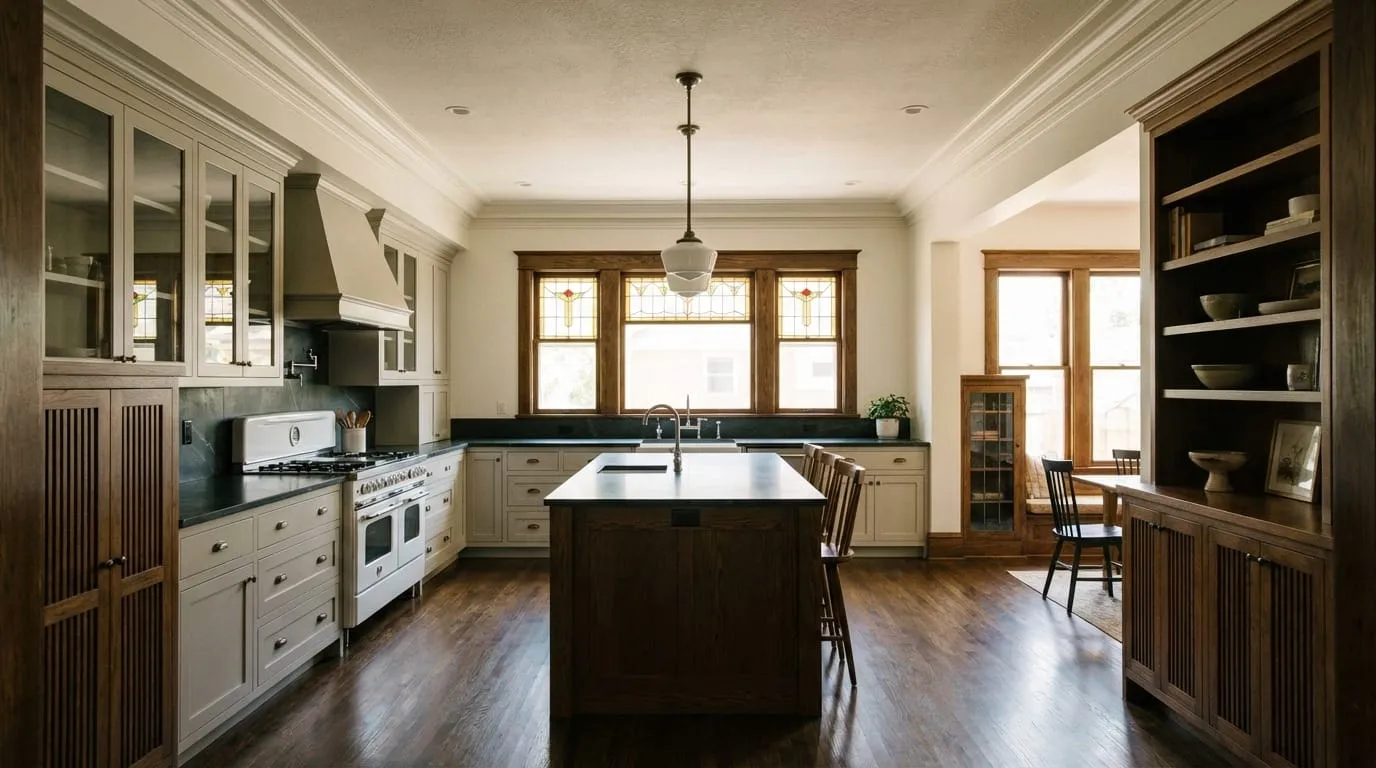
Historic Home Remodels Northern Utah
Preserving Northern Utah's Architectural Heritage Since 1976
From Victorian homes in Salt Lake City's Avenues to mining-era cottages in Park City, Northern Utah's historic properties require specialized renovation expertise. Cherrywood Construction has spent 50 years learning how to preserve architectural character while bringing century-old homes into the modern era.
Get Free Historic Home Remodels QuoteHistoric Home Renovation Experts for Northern Utah Properties
Renovating a historic home in Northern Utah demands a contractor who understands both preservation principles and the practical realities of our region. At Cherrywood Construction, we've spent 50 years working in Salt Lake City's Avenues Historic District—Utah's largest locally-designated historic district with over 100 architect-designed homes from the Victorian, Queen Anne, Prairie, and Craftsman periods. We've restored mining-era cottages along Park City's Main Street and renovated Victorian mansions in Ogden's Jefferson Avenue Historic District, where homes built between 1880 and 1905 document the city's railroad prosperity.
Historic renovation in Northern Utah presents challenges that go beyond aesthetics. Many of these homes were built with materials and methods that behave differently in our climate than modern construction. Original brick masonry was designed to "breathe"—exterior bricks fired at high temperatures protected softer interior bricks, with lime-based mortar acting as a sacrificial element during thermal expansion. When previous owners applied paint or waterproof coatings, they trapped moisture that now causes spalling during our severe freeze-thaw cycles. We understand how to repair this damage while restoring proper moisture management.
Working in Northern Utah's designated historic districts requires navigating a specific approval process. Salt Lake City's Historic Preservation Program requires a Certificate of Appropriateness for any exterior changes in locally-designated districts like the Avenues, South Temple, and University neighborhoods. Park City's Preservation Board, established in 1981, oversees all exterior modifications in the Main Street Historic District—even paint color changes require approval. In Ogden, the Jefferson Avenue Historic District maintains strict Victorian design standards. Our familiarity with these review boards and their design guidelines helps projects move through approval efficiently.
Utah's historic buildings also qualify for significant financial incentives when renovated according to preservation standards. The Utah Historic Preservation Tax Credit provides a 20% nonrefundable credit on rehabilitation costs exceeding $10,000 for properties listed on the National Register of Historic Places. Combined with the Federal Historic Tax Credit for income-producing properties, owners can offset up to 40% of qualified rehabilitation expenses. We help homeowners determine eligibility and coordinate with the State Historic Preservation Office to ensure projects meet the Secretary of the Interior's Standards for Rehabilitation.
Northern Utah Historic Renovation Considerations
Salt Lake City's Historic Districts
The Avenues Historic District, listed on the National Register since 1978, contains homes built from the 1860s through 1930 in styles including Queen Anne, Victorian Eclectic, Prairie, Craftsman, and Tudor Revival. South Temple features some of the city's most elaborate Victorian and early 20th century mansions. The locally-designated Sugar House district preserves early commercial and residential character. Each district has specific design standards enforced through the Certificate of Appropriateness process, and any exterior work—from window replacement to additions—requires review by the Historic Landmark Commission.
Ogden's Railroad-Era Architecture
Ogden's Central Bench Historic District covers 80 blocks with nearly 3,300 buildings dating from the 1860s through 1940. The Jefferson Avenue Historic District, formed in 1998, preserves Victorian homes built during the city's railroad prosperity between 1880 and 1905—many owned by prominent financiers including members of the Eccles banking family. Victorian architectural elements in these homes include asymmetrical facades, arched windows, patterned shingles, and leaded glass. The adjacent Historic 25th Street commercial district retains its character from the transcontinental railroad era.
Park City's Mining Heritage
Park City's Main Street Historic District, listed on the National Register in 1979, preserves the state's best remaining mining-town commercial district. The Mining Boom Era Residences Thematic District protects residential structures from 1872-1929, including T- and L-cottages, hall-parlor homes, and foursquare designs typical of mining communities. Park City's Preservation Board requires approval for all exterior changes, and the city offers matching grants through its Historic District Grant Program for renovations meeting historic standards.
Climate Challenges for Historic Structures
Northern Utah's freeze-thaw cycles—among the most severe in the nation—create specific challenges for historic buildings. Original lime-based mortar was designed to be softer than the brick, absorbing thermal stress and allowing moisture to escape. When this mortar is replaced with modern Portland cement, the brick itself becomes the weak point and spalls. Paint and waterproof coatings trap moisture that causes damage when it freezes. We use historically-appropriate lime mortar for repointing and remove problematic coatings to restore proper moisture management.
Historic Renovation Services for Northern Utah Homes
Our expert contractors specialize in all types of historic home remodels projects.
Victorian & Queen Anne Restoration
Restoration of Northern Utah's Victorian-era homes, common in Salt Lake City's Avenues and Ogden's Jefferson Avenue district. These homes feature asymmetrical facades, decorative millwork, and period-specific details that require specialized restoration techniques.
- Decorative millwork repair and replication
- Original window restoration or period-appropriate replacement
- Porch column and balustrade restoration
- Exterior paint analysis and period-appropriate colors
- Interior woodwork refinishing and repair
Craftsman & Bungalow Renovation
Renovation of Craftsman and Bungalow-style homes built throughout Northern Utah from 1905-1930. These homes dominate Salt Lake City's Northwest Historic District and are common in Ogden's Central Bench area.
- Built-in cabinetry preservation and matching
- Original hardware restoration and reproduction
- Exposed beam and woodwork refinishing
- Period-appropriate lighting and fixtures
- Fireplace tile and masonry restoration
Mining-Era Home Renovation
Specialized renovation for Park City's mining-era cottages and residences dating from 1872-1929. These include T- and L-plan cottages, hall-parlor homes, and modest workers' housing with distinctive mountain-community character.
- Board-and-batten and clapboard siding repair
- Simple trim detail preservation
- Foundation stabilization for settling structures
- Roof replacement matching original profiles
- Sensitive additions per Park City guidelines
Historic System Upgrades
Discreet integration of modern electrical, plumbing, and HVAC systems into historic homes. We route new services through less significant spaces and conceal modern infrastructure while meeting current building codes.
- Electrical upgrades meeting NEC requirements
- Plumbing replacement with minimal wall disruption
- High-efficiency HVAC with concealed routing
- Insulation improvements per Secretary's Standards
- Code compliance without character loss
Our Historic Renovation Process
Historic Assessment & Documentation
We evaluate your home's historic significance, document character-defining features, and research original construction methods and materials. For homes in designated districts, we review specific design guidelines that apply to your property.
Design for Preservation
Work with designers experienced in Northern Utah's historic architecture to plan renovations that preserve significant features while accommodating modern needs. We identify which elements must be retained, which can be sensitively modified, and where modern systems can be discreetly integrated.
Review Board Coordination
We prepare and submit Certificate of Appropriateness applications to Salt Lake City's Historic Landmark Commission, Park City's Preservation Board, or other applicable review bodies. Our familiarity with local guidelines helps anticipate concerns and address them proactively.
Tax Credit Documentation
For eligible properties, we coordinate Part 1 and Part 2 applications with the State Historic Preservation Office, documenting how proposed work meets the Secretary of the Interior's Standards for Rehabilitation.
Period-Appropriate Construction
Skilled craftspeople execute the renovation using historically-appropriate methods—lime mortar repointing, wood window restoration, millwork replication, and careful integration of modern mechanical systems.
Final Certification
For tax credit projects, we document completed work and submit Part 3 applications for final certification. We provide documentation of methods and materials used for your records and any future preservation work.
Licensed & Insured
- • Utah licensed general contractor
- • Fully bonded and insured
- • Workers compensation coverage
- • Liability insurance protection
- • Building code compliance
Quality Assurance
- • Regular quality inspections
- • Premium materials and suppliers
- • Skilled local craftspeople
- • Warranty protection included
- • Third-party inspections coordinated
HISTORIC HOME REMODELS THROUGHOUT NORTHERN UTAH
We provide historic home remodels services across the Wasatch Front and Wasatch Back. Our local expertise means we understand the unique requirements of each community.
RELATED SERVICES
Explore our other construction and remodeling services throughout Northern Utah.
Historic Home Remodels Northern Utah FAQ
Common questions about renovating historic homes in Northern Utah
If your home is in a locally-designated historic district like the Avenues, South Temple, or University, you need a Certificate of Appropriateness for exterior changes. This includes window replacement, siding work, additions, and sometimes paint colors. The Historic Landmark Commission reviews applications to ensure changes are compatible with the district's historic character. Interior work generally doesn't require historic review unless it affects the building's structural integrity. We help navigate this process and prepare applications that address the Commission's concerns.
Utah offers a 20% nonrefundable tax credit for rehabilitation of residential historic buildings listed on the National Register of Historic Places. Project costs must exceed $10,000, and work must follow the Secretary of the Interior's Standards for Rehabilitation. The credit can be carried forward for five years if it exceeds your tax liability. When combined with the Federal Historic Tax Credit on income-producing properties, owners can receive up to 40% back on qualified expenses. We help determine eligibility and coordinate with the State Historic Preservation Office on required applications.
Utah has one of the highest freeze-thaw rates in the nation, and this creates specific problems for historic brick. Original masonry was designed as a breathable system—soft lime mortar absorbed thermal stress while allowing moisture to escape. When moisture gets trapped by paint, waterproof coatings, or hard Portland cement repointing, it freezes inside the brick and causes spalling (pieces breaking off). We use historically-appropriate lime mortar for repointing, remove problematic coatings, and restore proper moisture management to prevent ongoing damage.
Yes, but additions in historic districts must be compatible with the original home while being distinguishable as new construction—you can't create a "fake historic" addition. Salt Lake City, Park City, and Ogden each have specific guidelines for additions to historic properties. Generally, additions should be located at the rear or a secondary elevation, set back from the original facade, use compatible but not identical materials, and maintain the original home's visual prominence. We design additions that satisfy these requirements while meeting your needs for additional space.
Salt Lake City's Avenues contains Victorian Eclectic, Queen Anne, Prairie, Craftsman, Mediterranean, Tudor, and Art Moderne homes built from the 1860s through 1930. Ogden's Jefferson Avenue district is predominantly Victorian (53%) with Four Square homes appearing after 1903. Park City's residential historic district includes T- and L-cottages, hall-parlor homes, and modest mining-era workers' housing. Across all districts, Craftsman bungalows are common from the early 20th century. Each style has specific character-defining features that must be preserved during renovation.
Sourcing period-appropriate materials is one of the challenges of historic renovation. We maintain relationships with architectural salvage dealers in the Salt Lake area who stock original hardware, light fixtures, and millwork. For items that must be reproduced, we work with specialty suppliers and craftspeople who can match original profiles and materials. The State Historic Preservation Office maintains a preservation directory of experienced contractors and suppliers. For tax credit projects, replacement materials must meet the Secretary's Standards—typically repair before replacement, and replacement in kind when repair isn't feasible.
READY FOR YOUR HISTORIC HOME REMODELS?
Get a free estimate for your historic home remodels project. Fast, safe, and professional service guaranteed.